
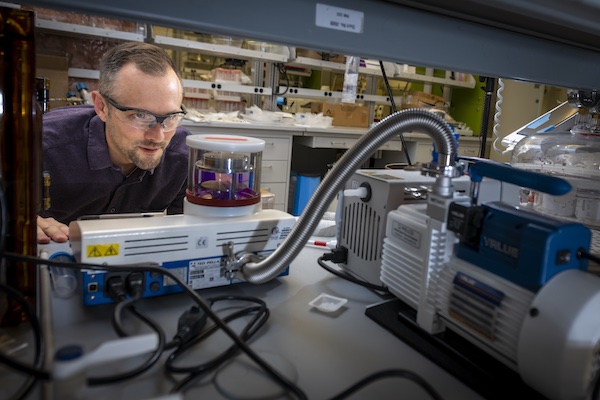
Michael Whittaker sits at the intersection of two worlds: the minerals we extract from Earth and the advanced materials we make from them. Though trained as a materials scientist, he recently shifted his focus from how things are made to what they are made from — a distinction that has never mattered more. Powering modern society through batteries, magnets, and optics now demands a far more complex array of elements than early technologies, some not domestically available. Understanding the fundamental science needed to source, process, and ultimately scale those materials — from atomic-level chemistry to industrial production — is the challenge at the heart of his work. In this Q & A, the staff scientist in the Energy Geosciences Division shares how he and Berkeley Lab geoscientists are helping lay the foundation for scaling up the science needed for the new material world.
 Q: How do geophysics and geochemistry enable more precise and responsible critical mineral discovery and recovery — and why does a deep understanding of mineral chemistry matter so much to the entire supply chain?
Modern technologies need far more elements than older ones did, and those elements aren’t always found domestically — so the U.S. faces two core challenges: locating these minerals and processing them into usable materials.
Geophysics and geochemistry work together here. Geophysics finds mineral deposits; geochemistry explains how they formed, helping predict where others might exist. But finding minerals is only part of the problem. Valuable elements rarely occur alone — they’re mixed with common minerals like quartz and feldspar, and some of those can produce toxic or radioactive byproducts during processing. This requires techniques that are highly specific but also capable of being conducted at industrial scale.
The good news is that the U.S. already mines much of what it needs. Critical elements often occur alongside materials we already extract, like silicon or gold. The bottleneck isn’t mining volume — it’s processing. That’s where Berkeley Lab’s capabilities in geochemistry, materials science, and separation chemistry become essential to building a reliable domestic supply chain.
Q: What are the biggest scientific barriers to getting critical minerals out of the ground and into the technologies that need them?
Since opening a new mine takes a decade and billions of dollars, the faster path is accelerating R&D rather than setting up new mines. The challenge is developing processes that work at every scale — from atomic-level chemistry all the way up to industrial operations handling millions of metric tons.
Two promising areas are beneficiation and separation. Beneficiation happens before chemical separation — it uses crushing, grinding, gravity, and flotation to concentrate target minerals. This work is being scaled up at Berkeley Lab by Chun Chang as part of METALLIC, a nine-lab initiative led by the National Energy Technology Laboratory focused on domestic critical mineral supply chains.
METALLIC works because each lab contributes something different. Berkeley Lab brings process separation expertise, while Idaho National Lab handles large-scale processing — taking hundreds of metric tons of raw ore from Wyoming mines and removing radioactive constituents. Together, the labs cover the full pipeline from raw ore to refined, purified metal.
Berkeley Lab is also investing in more fundamental research through the MINES project, funded by DOE’s Basic Energy Sciences program. MINES focuses on understanding the precise chemical form that critical elements take within complex mixtures — knowledge needed to develop new separation approaches and alternative materials like disordered rocksalts.
One notable result from MINES is a method to convert carbon captured from the air directly into graphite, offering a potential alternative to mining it. The team built a custom microscope to observe molten-salt electrolysis — a process that uses electricity and hot liquid salts to transform carbon dioxide into solid carbon. It’s an example of how fundamental chemistry research can open unexpected pathways to critical materials.
Q: How are AI and machine learning changing the way we find, process, and optimize critical minerals — and where is the biggest near-term impact?
AI is accelerating critical minerals research on two fronts: finding deposits and processing them more efficiently.
On the exploration side, Yuxin Wu has developed AI-enabled sensors that can be mounted on ground or aerial vehicles to map surface waste and identify concentrations of critical minerals — already cutting the time and cost of that work.
The bigger near-term impact, though, is in processing. Machine learning can now screen thousands of possible chemical reactions to predict the most efficient extraction routes before any lab work begins — identifying, for example, how a mineral might behave under lower temperatures or reduced acidity. This is especially valuable for unconventional sources like mine tailings, coal refuse, and processing byproducts, which don’t require new mines but do require smarter chemistry.
Those predictions feed directly into autonomous laboratories like A-Lab and REACT, which test and iterate far faster than traditional research teams. Through METALLIC, Berkeley Lab is building autonomous systems that mix minerals with various additives, apply heat, and work to selectively extract elements like lithium, magnesium, and copper. The key to making autonomy work is AI that can analyze results and suggest the next experiment, closing the cycle between prediction and experiment in a way that dramatically compresses the R&D timeline. This approach is still relatively new to the critical minerals space, particularly at commercial scale, but it’s an area where Berkeley Lab sees significant opportunity to expand.
