
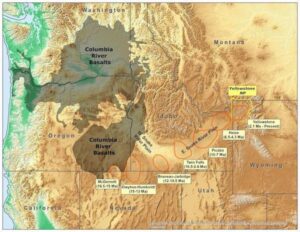
Map of the northwestern U.S., showing the approximate locations of Yellowstone hotspot volcanic fields (orange) and Columbia River Basalts (gray). The location of the McDermitt caldera is shown at the Oregon-Nevada line. Credit: Yellowstone
The U.S. remains heavily reliant on lithium imports, despite it hosting the world’s largest known lithium deposits (5.1 Mt Li) within the McDermitt Caldera mudrocks in southeast Oregon. As one example of how EESA advances the knowledge needed to unlock minerals from unconventional sources, our researchers are leading efforts to overcome decades of stagnation in lithium extraction — stagnation driven by longstanding gaps in geological understanding and the absence of critical extraction technologies. Because conventional extraction methods are designed for hardrock lithium deposits, their work instead leverages the unique characteristics of these soft, clay-like mudrocks — such as their large surface areas — to separate the lithium using less water, energy, and chemicals.
The research teams are multidisciplinary, combining expertise in geology and economic geology, clay mineralogy, and chemical and mineral processing engineering. Project ELM (Enabling Lithium Mudstone) aims to pinpoint the exact location of lithium within the McDermitt Caldera deposits in order to design an efficient separation process. The team is also identifying other valuable materials within the rock, such as molybdenum and gallium, and experimenting with three novel separation methods that use significantly less heat, water, and chemicals than conventional approaches.
Also focused on the McDermitt Caldera, Project PRISM (Processing Minerals into Sustainable Materials) aims to build a blueprint for a commercial-scale, end-to-end lithium extraction process that drastically reduces waste, water, and harsh chemical use. The team brings expertise in minerals and materials, process optimization, sustainable engineering, and contaminant separation, and will also apply AI and machine learning to automate ore characterization and scale operations. The project is designed to co-produce lithium alongside up to 10 other valuable materials, such as magnesium and synthetic graphite — the latter of which is expected to see 25-fold growth in global demand by 2040.
