
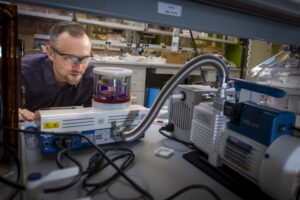
Michael Whittaker, Staff Scientist, Energy Geosciences Division (EGD), prepares core samples of rock using a glow discharge device to remove unwanted material from the sample as he researches better ways to extract lithium and other valuable minerals.
With the U.S. sourcing 80% of its critical minerals from abroad — and relying entirely on imports for materials such as titanium and gallium — supply chain disruptions pose serious risks to industries including advanced electronics, aerospace, and defense. EGD researchers, drawing on expertise in materials science, geophysics and geochemistry, and advanced computational methods, are working to mitigate these risks and accelerate the development of domestic critical mineral supply chains.
EGD leads Berkeley Lab’s contributions to a major DOE initiative focused on critical mineral supply chain security, the Minerals to Materials Supply Chain Facility (METALLIC). This effort, led by NETL (the National Energy Technology Laboratory), builds upon existing Department of Energy efforts focused on unifying the physical, computational, and data capabilities of nine national laboratories to accelerate new critical mineral and material (CMM) supply chains. As a key participant in METALLIC, Berkeley Lab contributes expertise in CMM process modeling, optimization, and the application of AI/ML to signature projects, including “Mine to Magnet” (focused on establishing a domestic rare earth permanent magnet supply chain) and “Muck to Metals and Graphite” (focused on converting legacy industrial waste into high-quality battery-grade graphite).
The MINES (MINeral to Energy Storage Synthesis Science) project takes a comprehensive approach to overcoming barriers in large-scale energy storage. The team aims to understand the specific chemical form of critical elements in complex mixtures in order to enable new separation approaches, and develop alternative materials such as disordered rocksalts and lithium iron phosphates. Their goal is to reduce dependence on critical minerals like cobalt, and to accelerate materials discovery by exploiting extreme conditions primarily related to high-temperature and high-pressure environments.
