
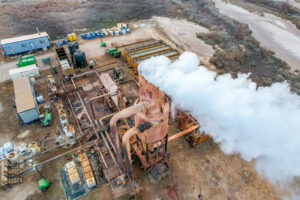
Geothermal power plant in Imperial County, California, near the Salton Sea Geothermal Field. Credit: Jeremy Snyder/Berkeley Lab
Geothermal brines, a byproduct of geothermal electricity generation, can contain high concentrations of valuable minerals such as lithium, iron, magnesium, and zinc. Despite this potential, produced brine from geothermal fields around the world has historically been re-injected back underground — largely because effective methods for separating these mineral resources from hot brine have not been well understood.
Scientists at Berkeley Lab within the Earth and Environmental Sciences and Energy Technologies Areas, drawing on expertise in geothermal environments, techno-economic analysis, and materials science, are leading efforts to change this. Their research focuses on lithium and other critical elements found in two distinct geological settings: the “superhot,” ultra-deep zones of the geothermal field beneath the Salton Sea, and the Smackover Formation, where lithium originates and migrates from rock to brine under lower-temperature conditions. Because the geochemical processes driving lithium transfer differ significantly between these two environments, each site offers unique and complementary insights into how mineral-rich brines form and how their resources might ultimately be recovered.
Extending from western Texas to northern Florida along the Gulf of Mexico coast, the Smackover Formation is a limestone aquifer that has been extensively used for oil and gas production. The goal of this project is to study the lithium “cycle” within the Smackover Formation, investigating the source of lithium, how much of it accumulates in minerals and fluids, and where the element ultimately is extractable.
Berkeley Lab scientists led a previous research effort to characterize and capture lithium from the geothermal brine beneath California’s Salton Sea which concluded in 2023 with a report called Characterizing the Geothermal Lithium Resource at the Salton Sea. The work of the multidisciplinary team continues, with additional geologic studies and analysis of potential extraction techniques.
